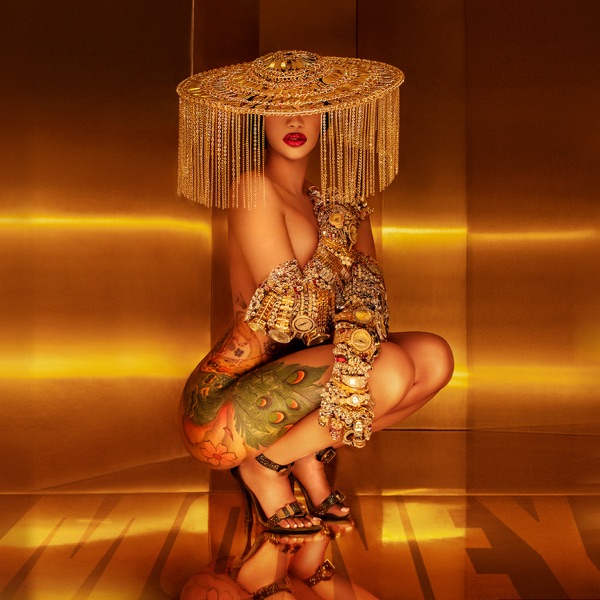
Money
Cardi B · Money - Single
A loud celebration of money, sex, and violence with no deeper reach.
Where the words land
Signal: At Odds.
What do these signals mean?
- Edifying: Points the heart toward God, truth, hope, or love.
- Worth Weighing: Real good and real concern together. Test it before you take it in.
- Strained: Strains against Scripture: leans toward what could dull or mislead.
- At Odds: At odds with Scripture: celebrates what it warns against. Little here builds up.
Weighed against Scripture
“But nothin' in this world that I like more than checks”
“No one can serve two masters: Either he will hate the one and love the other, or he will be devoted to the one and despise the other. You cannot serve both God and money.”
Jesus warns that you cannot serve both God and money; this song openly names money as the supreme love of the heart.
“I don't really need the D, I need the (money)”
“He who loves money is never satisfied by money, and he who loves wealth is never satisfied by income. This too is futile.”
The Preacher says whoever loves money never has enough; the song's refrain mirrors that endless craving without any awareness of its emptiness.
“I was born to flex, diamonds on my neck”
“Instruct those who are rich in the present age not to be conceited and not to put their hope in the uncertainty of wealth, but in God, who richly provides all things for us to enjoy.”
Scripture warns against putting hope in uncertain riches rather than God; here riches are the explicit source of identity and hope.
The song as a whole
Do not avenge yourselves, beloved, but leave room for God’s wrath. For it is written: “Vengeance is Mine; I will repay, says the Lord.”
Paul calls believers to leave vengeance to God, while these lines glorify personal violent retaliation as a badge of strength.
“For all that is in the world — the desires of the flesh, the desires of the eyes, and the pride of life — is not from the Father but from the world.”
The lust of the flesh, the lust of the eyes, and the pride of life summarize the song's overall posture of self-glorification through sex, violence, and wealth.
Words of Christ are set in red.
In short
This is a flex anthem built entirely around wealth, sexual power, and dominance, with violent threats laced throughout for emphasis. There's real skill and confidence in the delivery, and a passing mention of her daughter (Kulture) hints at something tender beneath the bravado, but the song never reaches past material and physical triumph. It's a celebration of self and status rather than any kind of searching or gratitude.
- Lyrical content
Heavy profanity, sexual boasting, violent threats, and explicit materialism run through nearly every line.
- Spiritual posture
The song centers self-exaltation and wealth as the ultimate good, with worth measured in cash, sex appeal, and dominance over others.
- Apparent intent
Cardi's intent seems to be a confident flex anthem celebrating hard-won wealth and sexual power, cathartic for her own rags-to-riches story but not reaching toward anything beyond self.
What do these ratings mean?
- Lyrical content, what the words say on the surface. Clean: nothing coarse, sexual or violent. Mild: a trace of it, by allusion or a rare word. Strong: profanity, sex or violence in plain words. Explicit: graphic, or sin held up to admire.
- Spiritual posture, where the song's heart points. God-honoring: toward God, truth or hope. Searching: honestly reaching or wrestling toward truth, without arriving. Neutral: spiritually indifferent; neither reaches nor rejects. Dark: despairing, nihilistic, self-exalting or hostile to God.
- Apparent intent, what the song is for. Edifying: worship, encouragement, honest lament. Cathartic: letting grief, anger or longing out, told honestly. Ambiguous: hard to say what the song is for. Harmful: celebrates evil, mocks faith or draws toward sin.
Does this song's vision of what makes a person valuable match what you actually want to believe about worth?
An AI-assisted reading. It can misread a lyric, a metaphor or a song’s intent.


