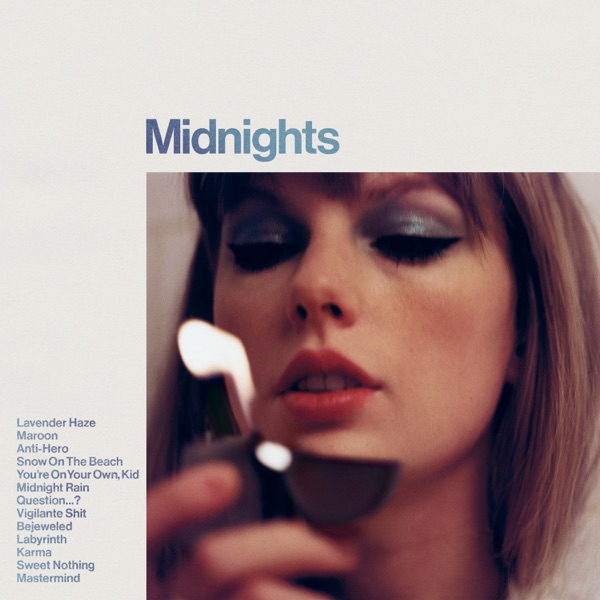
Anti-Hero
Taylor Swift · Midnights
Honest self-indictment with no landing place beyond guilt
Where the words land
Signal: Worth Weighing.
What do these signals mean?
- Edifying: Points the heart toward God, truth, hope, or love.
- Worth Weighing: Real good and real concern together. Test it before you take it in.
- Strained: Strains against Scripture: leans toward what could dull or mislead.
- At Odds: At odds with Scripture: celebrates what it warns against. Little here builds up.
Weighed against Scripture
“I get older but just never wiser”
“I do not understand what I do. For what I want to do, I do not do. But what I hate, I do. And if I do what I do not want to do, I admit that the law is good. In that case, it is no longer I who do it, but it is sin living in me that does it. I know that nothing good lives in me, that is, in my flesh; for I have the desire to do what is good, but I cannot carry it out. For I do not do the good I want to do. Instead, I keep on doing the evil I do not want to do.”
Paul's own confession of doing what he hates mirrors this song's baffled self-awareness of repeated failure.
“I should not be left to my own devices”
“The heart is deceitful above all things and beyond cure. Who can understand it?”
The admission that she can't trust her own impulses lines up with Scripture's warning that the heart is deceitful and often needs outside correction.
“covert narcissism I disguise as altruism”
“Be careful not to perform your righteous acts before men to be seen by them. If you do, you will have no reward from your Father in heaven. So when you give to the needy, do not sound a trumpet before you, as the hypocrites do in the synagogues and on the streets, to be honored by men. Truly I tell you, they already have their full reward. But when you give to the needy, do not let your left hand know what your right hand is doing, so that your giving may be in secret. And your Father, who sees what is done in secret, will reward you.
Jesus warns against doing good for show; naming this pattern in herself is a rare moment of real self-exposure rather than denial.
“I'm the problem, it's me”
“For I know my transgressions, and my sin is always before me. Against You, You only, have I sinned and done what is evil in Your sight, so that You may be proved right when You speak and blameless when You judge.”
David's confession 'I know my transgressions' shares this song's blunt ownership, though David's leads to repentance before God while this song stops at self-diagnosis.
The song as a whole
“What a wretched man I am! Who will rescue me from this body of death? Thanks be to God, through Jesus Christ our Lord! So then, with my mind I serve the law of God, but with my flesh I serve the law of sin.”
Paul's cry 'who will deliver me' finds an answer in Christ; the song's self-loathing has no such rescue in view, just the loop of guilt.
Words of Christ are set in red.
In short
This is Taylor Swift turning the mirror on herself with unusual bluntness, naming her self-destructive patterns, pride, and fear that she's fundamentally the problem in her own relationships. It's catharsis through self-mockery, not despair for despair's sake, but it also never moves past guilt toward anything resembling grace or forgiveness. The confession is real; the resolution isn't there.
- Lyrical content
No profanity of note; the content is confessional self-mockery, dark imagery of depression, narcissism, and a nightmare about her own death.
- Spiritual posture
She names her own self-loathing, pride disguised as altruism, and fear of being unlovable with unusual honesty, even if she never reaches past the self-diagnosis toward grace.
- Apparent intent
This reads as wry self-examination rather than celebration of the flaws it describes; the humor softens but doesn't erase the real ache underneath.
What do these ratings mean?
- Lyrical content, what the words say on the surface. Clean: nothing coarse, sexual or violent. Mild: a trace of it, by allusion or a rare word. Strong: profanity, sex or violence in plain words. Explicit: graphic, or sin held up to admire.
- Spiritual posture, where the song's heart points. God-honoring: toward God, truth or hope. Searching: honestly reaching or wrestling toward truth, without arriving. Neutral: spiritually indifferent; neither reaches nor rejects. Dark: despairing, nihilistic, self-exalting or hostile to God.
- Apparent intent, what the song is for. Edifying: worship, encouragement, honest lament. Cathartic: letting grief, anger or longing out, told honestly. Ambiguous: hard to say what the song is for. Harmful: celebrates evil, mocks faith or draws toward sin.
Does naming your flaws this clearly open a door toward grace, or just loop you back into the same self-judgment?
An AI-assisted reading. It can misread a lyric, a metaphor or a song’s intent.